Research by Robert J. (BoB) Bishop and Matthew Bishop for MICDE 2026 and ASA SMI 2026. A physical dice experiment — begun while they ran an ambulatory surgery center, written up in Matt’s 2018 UMass Boston thesis — tested whether Shannon entropy alone can predict how oriented physical work unfolds. It could not. Left- and right-handed configurations appeared only when someone actually spun the dice (do(spin)). The tabs walk through Pearl’s three causal levels, Constructor Theory, and the pre-operative T* line.
This link was shared in a reply to Judea Pearl’s point that Shannon information theory must be joined to causal level 2 (intervention) and level 3 (counterfactuals). This page is the public record: demos, trial photos and video, poster PDFs, and Matt’s 2018 thesis. Authors: BoB Bishop (@bishopb0b) and Matthew Bishop · jointspace.org
The Dice Experiment
Pearl Level 2 · InterventionShannon entropy did not predict the measured spin times. Only doing the spins — repeated physical do-actions — showed left- and right-handed dice that entropy scores as the same.
Chirality only appears when three faces meet at a corner — a single face cannot show handedness.
Both dice show 1 on the front face (Shannon sees "same"). The top ↔ right ordering (3·2 vs 2·3) reveals the mismatch entropy misses.
Right-handed
corner: 1 · 2 · 3
CONVERTS
Left-handed
corner: 1 · 3 · 2
I wanted to understand real work in the world. So I spun dice — many times — and wrote down what happened.
The old Information Entropy math gave the same number to both handednesses. The real times did not match. That break was the beginning.
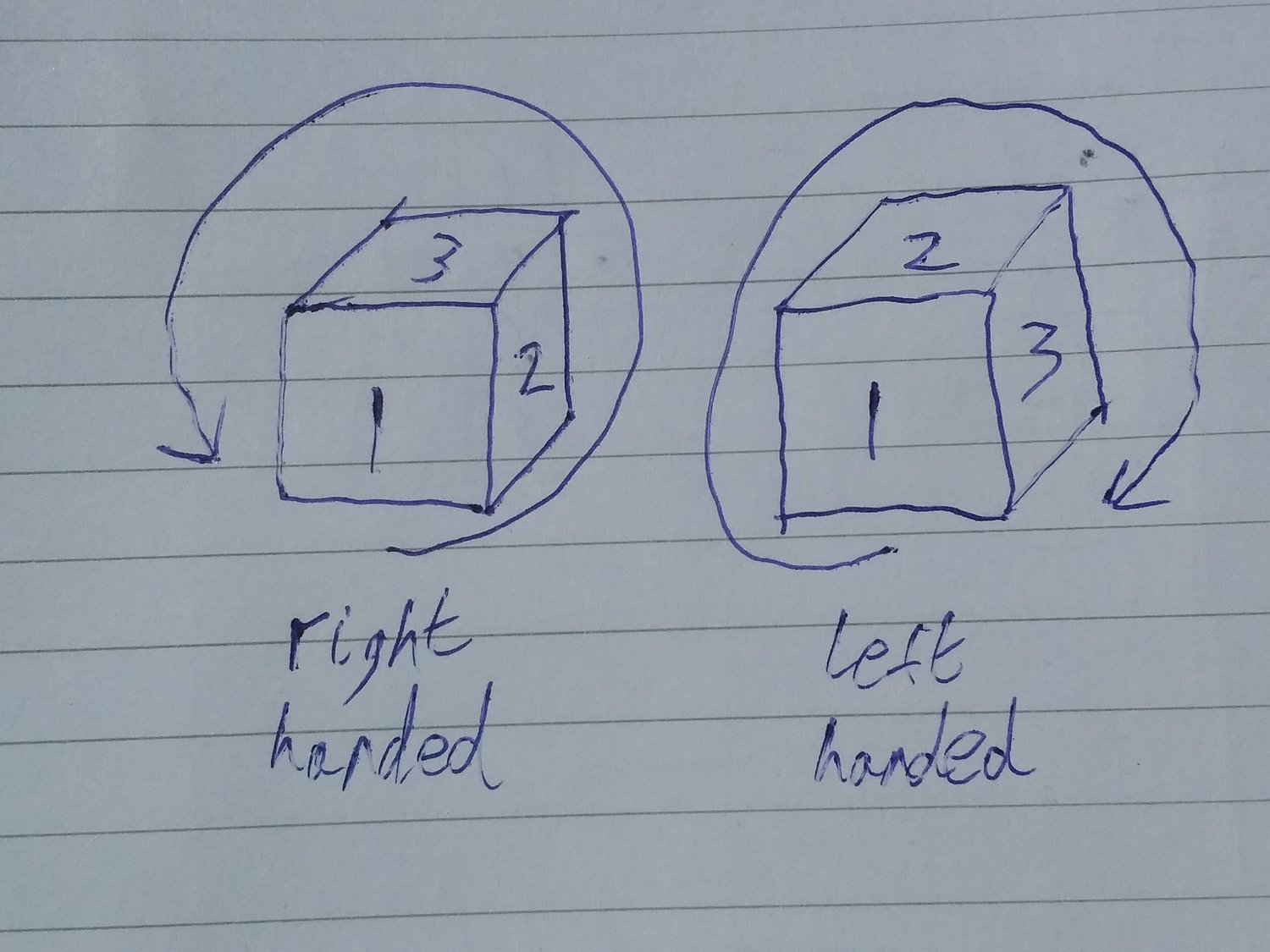
Bob's original sketch — same 1·2·3 vs 1·3·2 corner logic as the interactive dice above. No rotation converts one into the other.
The dice study is a Level 2 do-action. Shannon (Level 1) failed. Only intervention on the real world revealed what probability alone could not.
📊 Empirical Falsification — 8 Dice Ensemble
Real physical trials8 dice, each placed in a different starting orientation. Every trial ends in the same final state. Trials were repeated to build ensemble distribution curves — testing whether Shannon entropy could predict completion time from start configuration alone.
It could not. Spin orientation and path-dependent assembly mattered — variables probability treated as invisible.
Click any frame to enlarge
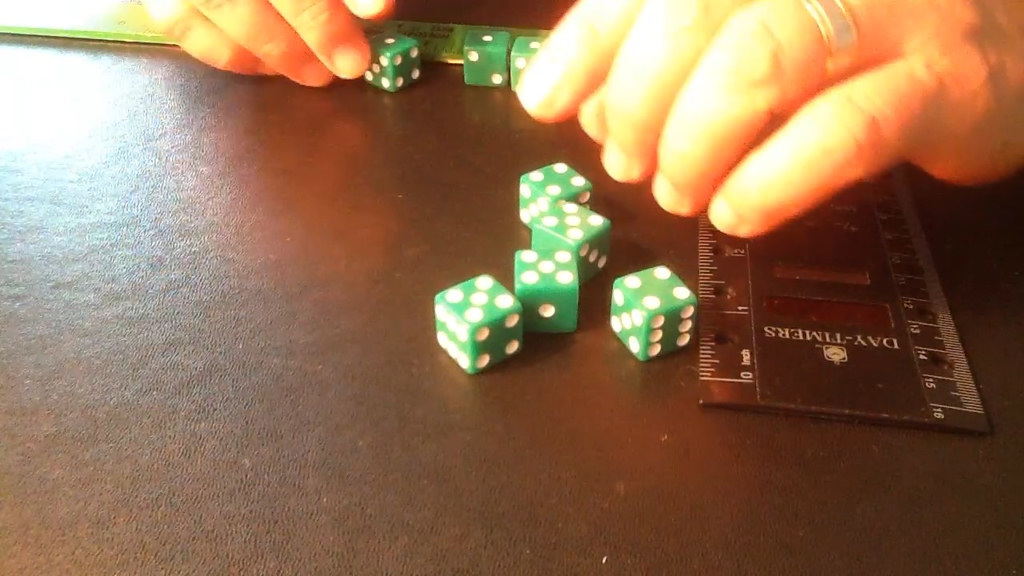
Varied starts — green dice cluster, each die in a different orientation
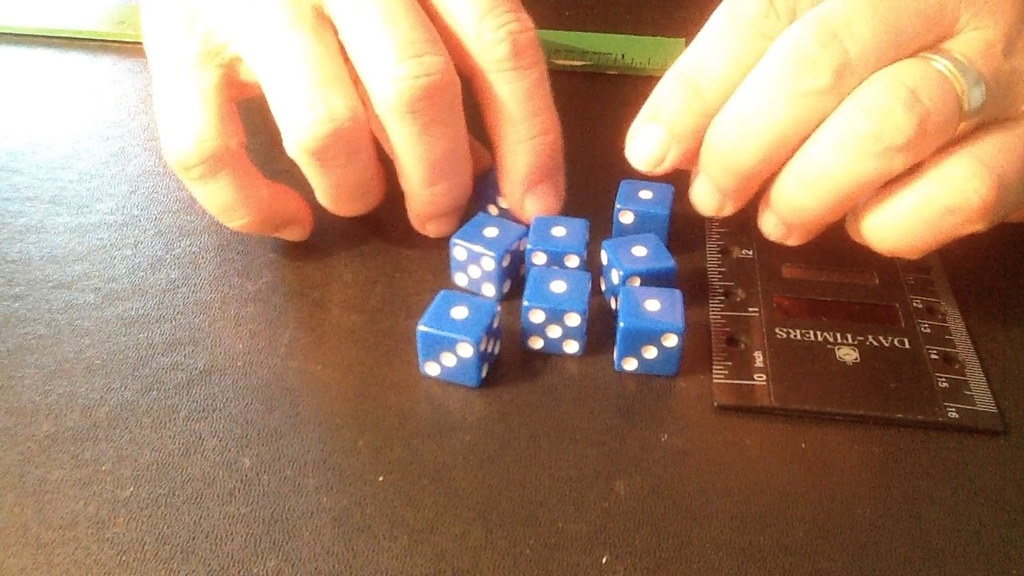
8 blue dice — different starting states, ruler for scale
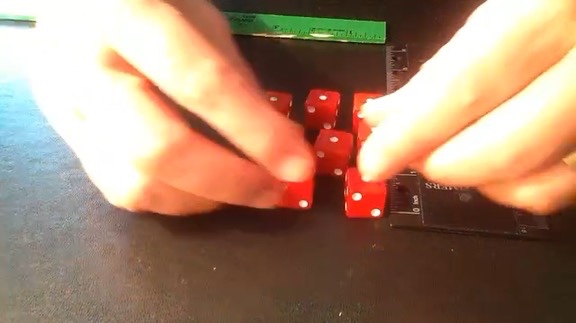
Hands on task — active do-action placing each die's spin orientation
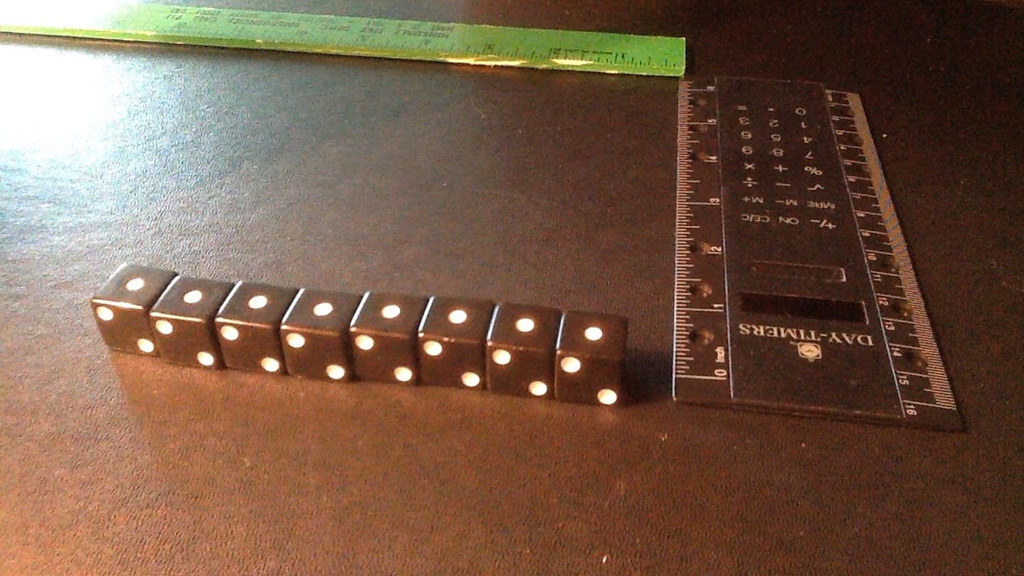
Same ending — all 8 dice converge to identical final orientation
Video — one 8-dice trial
Physical trial footage (2018). Different starts → same end. Repeated hundreds of times for ensemble curves.
💡 The Aha Moment — Spin Orientation in Typewritten Text
Discovery Bob judged importantWhile working through the dice data, Bob realized that typewritten pages carry spin orientation — not just on/off bits. Letters, Morse code, Nyquist–Hartley–Shannon information: all projected onto a single axis, blind to the 3D oriented states the dice experiment had made visible.
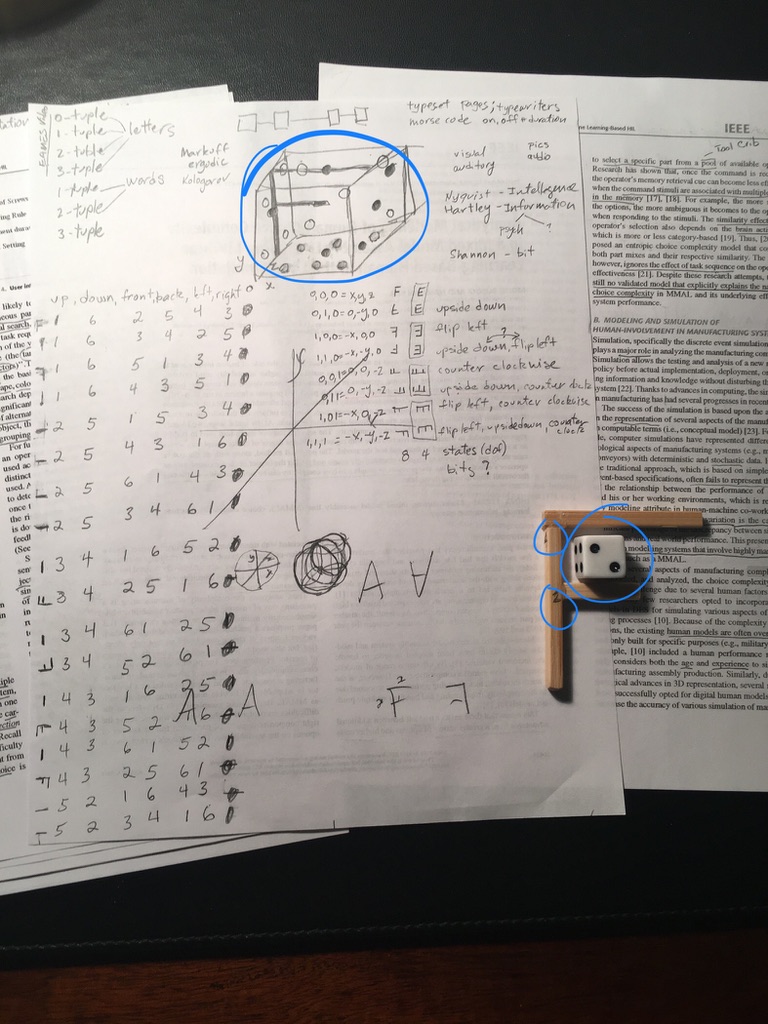
Bob's lab notes (circled cube, orientation table: upside down · flip left · counter clockwise → "8 states (dot) bits ?"). A real die is wired to the page — orientation is physical, not symbolic.
Probability over bits cannot represent spin orientation, chirality, or the do-path through 3D state space. No do-path to communication improvement in surgery was found from entropy alone.
Pearl Levels 2 & 3 + Constructor Theory — intervention and counterfactual reasoning about oriented substrates. The dice study and these notes are the origin chain.
Click the notes image to view full resolution.
JointSpace Framework
Pearl Levels 2 & 3JointSpace is the contact surface where a living agent and a tool exchange force and information. A joint reconstruction is one such surface: anatomy and engineered materials meet through a fixed sequence of constructor operations.
Central Claim
JointSpace is the interface that relates nerves to machines during a real procedure.
- • Constructor Theory (Deutsch & Marletto)
- • do-calculus (Pearl)
What Is JointSpace?
Any interface where an animate agent and inanimate system exchange information and force.
Possible vs Impossible — tap to flip
Team capacity meets procedure demand. Outcome reproducible.
Tap to see impossible →
Capacity below demand. Failure structurally guaranteed — not merely probable.
← Tap to flip back
Causal Pathway (SVG)
T* — The Pre-Operative No-Go Line
The culmination: when impossible physical movements make the planned assembly of do-operations a no-go zone.
T* (threshold T-star) is the boundary between a surgical case that can be caused by this team-constructor and one that cannot — regardless of skill, experience, or probability. Every planned procedure has an assembly index a: the minimum number of causally ordered constructor (do-) operations required, counting chirality, substrate matching, and path-dependent steps. The team has a validated constructor capacity T*(team). When demand exceeds capacity, the case enters the no-go zone.
Plain example — handedness makes the plan impossible
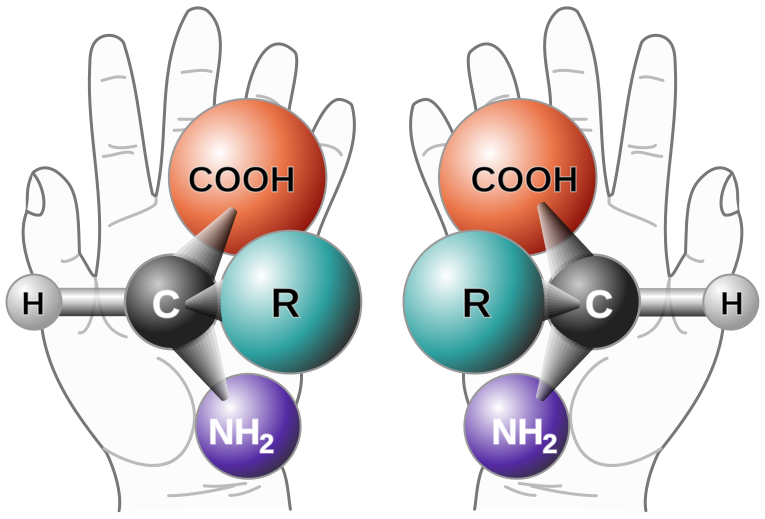
Your left hand is not your right hand. One's L cannot be turned into R — whether palms up or palms down. No rotation. No flip. That is handedness. The same rule applies to a surgical plan, a glove, or a tray: left is not right. The planned operation is impossible — not low-probability, not "risky."
Same logic as the dice: mirror images are not interchangeable. Only the substrate changes.
Try it yourself. Hold your hands in front of you — palms up, then palms down. Your left hand never becomes your right hand. Everyone has two hands; everyone can see this in ten seconds.
GO — matched handedness
Left task on left hand. Right task on right hand. Same side.
Matches ✓
NO-GO — wrong handedness
Left task on right hand. No rotation fixes it. Same logic as an L die on an R substrate.
Impossible ✗
The illustration on Wikipedia's chirality page — Chirality_with_hands.svg (NASA, public domain). Flip your own hands palms down: still not the same. Dice, implants, and pre-op plans obey the same rule.
Team constructor capacity meets or exceeds the procedure's assembly demand on this anatomy. Every do-operation in the chain is physically possible. Operating rhythm can be sustained.
A required do-operation cannot be caused — wrong chirality, wrong component, team capacity exceeded, or an impossible transformation in the assembly graph. Proceeding is structurally guaranteed to fail.
Why it matters: Shannon entropy and Rung 1 association (Pearl's "seeing" — P(outcome | features), regression, observational correlation) ask "how likely?" T* asks "can this be caused at all?" — answerable before the first incision. Wrong-handed plan, mismatched tray, team under assembly demand: catch them in the plan, not in the complication data.
T* is estimated from the procedure's chiral construction graph, substrate attribute transitions, the team's validated constructor history, and Ashby's Law of Requisite Variety. Pre-operative. Computable. Not a correlation.
Pearl’s three levels — open each rung
Ladder of CausationClick any rung on the ladder or cards →
Shannon & patterns live here → fails on chirality
do(dice study) reveals chirality — the exact operator in the posters
Mind reasons about impossible 720° twist + possible/impossible tasks
Level 2 = do(dice study) — the exact operator used in the posters. Pearl's do() cuts incoming causal paths and sets a variable directly. The team does not observe the procedure — it intervenes on every step. Instrument handoff (state ★), structured coordination, and Fractalscope parity flip are all do-actions.
→ Click other rungs on the ladder or cards above!
Volume is a confounder. Coordination is the mediator. Only do-calculus separates them.
🔄 Chirality & the Shannon Critique
Beyond Shannon entropyH = −Σ p(s) log₂ p(s) assigns the same value to left-handed and right-handed configurations.
Constructor theory + do-calculus: they are not the same world.
SU(2) Projections — toggle to compare
Shannon binary is correct for channel capacity across many transmissions. Structurally incomplete for a single chiral constructor operation.
The causbit is the physiological plexus — composite biological tissue carrying causal efficacy, not just symbols. The medium is the causal DAG made flesh.
Spinorial geometry (SU(2)): A spinor requires 720° to return — not 360°. The path of rotation carries physical meaning.
Handedness scales fractally: molecules → plexus → anatomy → instruments → team choreography → assembly pathway.
Level 3 counterfactual reasoningWhat it means
T* in one sentence
If the planned procedure demands do-operations that are physically impossible for the substrates involved — or beyond what this team can reliably cause — the case is in the no-go zone. Do not schedule it as if probability will save you.
Left on right = impossible plan. Same as your left hand ≠ your right hand — palms up or palms down. T* makes that visible at case-planning time.
Pre-Op Team Assignment
Not "is this surgeon experienced?" but: does this team's T* exceed the assembly index of this chiral procedure on this side (left vs right), with this tray and these components?
AI Coordination
Detect when a live case approaches T* — wrong instrument state, rhythm collapse, chirality mismatch in the chain — and signal before the no-go boundary is crossed.
Fractalscope
CHIRAL FLIP toggle = real do() on imaging data. Makes what Shannon averages away visible.
JointSpace.org
Patient-sovereign records preserving actual intervention sequence — structure averages cannot reconstruct.
2018 → 2026 — From Matt’s thesis to Pearl
Matthew Bishop ran an ambulatory surgery center with Bob, then modeled surgical complexity with dice for his UMass Boston undergraduate thesis (May 2018). The R work and the statistics were competent. The premise — that association licenses a change in tray layout — was not challenged until Pearl’s ladder entered the work. This tab is that sequence.
The knowledge arc
2018 · UMass Boston
Matt's thesis — Modeling of Surgical Complexity: A Dice Study
Real ASC experience with Bob. R, lm(), ANOVA, mean times by start state. Asked: does complexity predict time? (Pearl Rung 1.) Found proximate layout dramatically faster — but never formalized as do(tray layout).
2018–2026 · Empirical falsification
8 dice, different starts → same end — ensemble curves
Repeated physical trials. Shannon entropy predictions failed. Spin orientation and chirality invisible to standard stats. See Dice Spark tab →
Lab notes · Aha moment
Typewritten text has spin orientation
Bob's handwritten discovery: Shannon's bit collapses 3D oriented states. "8 states (dot) bits?" — entropy cannot find a do-path to communication improvement in surgery.
Pearl · Constructor Theory
Rung 2 do() + possible/impossible + T*
Intervention, counterfactuals, pre-operative no-go zone. Left on right = impossible plan — same as handedness. JointSpace tab → · Pearl Ladder →
2026 · MICDE & ASA
JointSpace posters — MICDE & ASA 2026
Eight years after the thesis, the framework answers what undergrad statistics could not permission: causal structure of surgical assembly.
What Matt's thesis actually found (2018)
The R pipeline was rigorous: tidy data, linear models, log transform when needed, Type II ANOVA. Dice Start State and Total Moves were highly significant predictors of time. The practical signal was unmistakable:
The thesis ends: "This is where we want to go!" — an implicit recommendation to reorganize trays. But associational significance was treated as if it licensed causal redesign. That leap was never formally made — or challenged.
What Matt was taught to ask (Rung 1)
- Null: complexity and actions are not related to time
lm(Time ~ StartState + Moves + DiceCount)- Is start state associated with completion time?
- Significant ANOVA → publish, recommend
- Entropy as predictor (often NA in early tables)
- Ensemble means over subjects (Bob, Matt, Robin, Ann…)
Correct for describing patterns. Never challenged whether regression was the right epistemic tool for a study whose purpose was to change tray layout.
What Pearl permissions (Rungs 2 & 3)
P(time | do(proximate layout))— intervention- Counterfactual: what if trays stayed shuffle-roll?
- Chirality: spin orientation, not just category labels
- T*: is this assembly possible for this team on this anatomy?
- Constructor: right implant on wrong-side femur = no-go
- do(spin) reveals what entropy averages away
The thesis hinted at Rung 2. JointSpace makes it explicit and computable pre-operatively.
Why wasn't Pearl front and center when Matt learned stats?
Undergrad statistics is still Fisher/Neyman–Pearson: hypothesis tests, p-values, regression as prediction. Causation appears as a footnote — not the object of study.
Thesis: May 9, 2018. Pearl's Book of Why: 2018. Formal do-calculus lived in grad epidemiology/CS — not UMass Boston's R + lm() track.
lm() and ANOVA answer associational questions frictionlessly. Causal DAG packages existed but weren't standard in undergrad applied stats.
Ground truth from running an ASC with Bob. The statistics never asked whether associational regression matched the embodied knowledge of how instruments move through 3D space.
Empirical falsification — same end state
Aha — spin orientation in text
Culmination: T*
Left on right — handedness mismatch. Planned operation impossible — not unlikely. The thesis measured time; T* measures whether the case belongs in the no-go zone at all.
Primary sources for this arc